Wednesday, October 17, 2012

Sam Scott: Order on the Amorphous Swarm (1981)

Sam Scott, photo by Bernard Plossu
 
When we called on Sam Scott at this hand-built Santa Fe adobe a few months ago, he impressed us as a friendly, bear of a man.  Tall and broad shouldered with a mop of brown hair and a heavy mustache, he was wearing the clothes of a working painter—paint splattered overalls and black work shoes.  His living room is warm and cluttered with friends’ art (a Larry Bell vapor drawing, a Paul Caponigro photo of a Japanese temple), books (Art and Artist, by Otto Rank, The Village Voice Anthology, tomes on DeKooning, Picasso, Cezanne), records, tapes, art supplies, coffee cups.  He made us a cup of tea, talked briefly about the past, learning that he first moved to Santa Fe in the late ‘60s, then to Arizona in the late ‘70s where he taught art for five years at the University of Arizona, before returning last year to the red clay that still tenaciously grips his art roots.  Then we slipped into an easy and wide ranging discussion of art and ideas.
Here’s an easy question—what do you do and why do you do it?
(Laugh followed by long pause)  Well, I’ve been painting since I was a child.  So I’m doing what I’ve always done.  There were some side trips, some questioning about the commitment, because it’s a frightening commitment to make, but it’s always been something I knew I had to do.  Why do I paint?  That’s simple, too.  It’s the glue that holds the world together for me.  I wouldn’t know what to do if I wasn’t painting.
What do you paint?
(Long pause)  Well, the interesting thing about art is that the part that really matters is the part you can’t speak about (laugh).  Right?  If we’re all interested in the fascinating thing of our . . . extraordinary privilege of being sentient beings . . . There’s all this methane out there and ice, and we exist on this moment of space-time, what an extraordinary privilege it is to be a sentient being, to have this exclusive human consciousness.  I think that there are many functions of art.  Art is big, it’s not little.  One function of art that interests me above all others that can be addressed in the art of painting is to experience experience.  If it is that, then it’s a statement of wonder before experience.  Then it’s celebrative, and in a way it’s art destroying itself.  The painting is a snakeskin, a cicada shell, a souvenir.  What really matters is how you feel when you’re painting.
You say “wonder before experience”?
As witnessing, as in front of.
On your knees?
Yes.  You’re right with me.  This is going to be fun.  Painting is about consciousness.  It’s a very moral statement, and that’s why Rothko wasn’t talking about light when he talked about the central issue of vibrato in a painting.  He was talking about something that was in the late works of Mozart.
For some reason this discussion reminds me of a quote I read some months ago in the New Yorker.  The article was examining the controversy over the legitimacy of psychoanalysis, and the writer said, “The unexamined life may not be worth living, but living the examined life is only possible for a moment at a time.”
That’s interesting.  I think painting connects both modalities, balances them.  Do you know Allen Bleimtraub’s Parable of the Beast?  It’s an analogue between behavioral characteristics of animals, and he was interested in what he calls significant time.  The common Rocky Mountain wood tick, in its juvenile life, will go out to the end of a twig and there go into a somniferous trance – however long it takes, ten, 20 years, it doesn’t matter.  The moment that it senses a certain collection of molecules that translate as animal sweat, it instantly is galvanized into action and leaps into space.  And this is what Bleimtraub calls significant time.  So in reference to your quote, both things are true, and I might add to that a quote by Helen Keller who said that life must be a high adventure or it’s not worth living.  I guess what we’re getting at is the idea of painting as a parable for a fulcrum that exists between those disparate parts.  Tillich uses a Spanish phrase, salto mortal, the leap of faith, or the mortal leap, that moment of movement between the known and the unknown, which essentially is the painter’s job, any artist’s job, going from the known to the unknown. 
You said over the years you’ve been on a number of side trips.  Were those significant times?
Some of it was, some of it wasn’t.  When I was in seminary that was very significant.  When I was in landscape architecture, it was a disaster.  These were things that happened while I was on my way to making a commitment as an artist.
It often seems that creative people go through those periods where they check out, either do nothing or do something unconnected with their creative endeavor, to recharge or refresh.
We’re electrical beings, our minds are alpha charges, our lives are always in some aspect dealing with the nutritive or the generative.  When you push hard enough, then you need to go to the nutritive, to receive, or else you don’t have anything to paint about.  As De Kooning said, “You can’t be a painting machine.”  If he had become a painting machine, he wouldn’t have the greatness he has now.  This glass of juice here (in his hand)—until it’s full, it can’t spill over.  So fill it up!
What are your work habits?
I’m a compulsive painter, but I like the luxury of a routine.  I need it.  I like to get up early, 5:30, and I like good coffee, go for a run with my dog.  That time while I’m running is preparation.  I run an hour . . . I regard myself as a weather painter, and it’s important for me to know what the day’s going to be like. The weather of the day has to do with the kind of painting I’ll do.  I like that link-up, immediacy.  Then I come back, make lunch for my kids (he has two sons, 5 and 12), get them off to school, and try hard to get into the studio by 9.  It’s a 9 to 5 trip.  Some nights I like to be with the kids, be close to the fire, and I’ll do watercolors on the table here.  I just got a real nice Eaton press, so I’ll be doing linocuts at night and woodblocks.  The time when I’m not with my kids I’ll go down to the studio.  In terms of the life stuff, I give over Mondays to paying bills, correspondence, laundry, and grocery shopping, and write off the studio that day.  So I have four very clean days and optional weekend time.  It’s important that I work as a painter like a truck driver works or a plumber or anyone else. Working seriously.  Discipline is freedom.  Otherwise, you’re a slave to time.  Art is about the language of freedom, and the only way to get it is to take it.  It’s not given. 
Black Angel (detail), oil on canvas, triptych, 66 x 240 inches
That’s not a comfortable notion for many people.  Maybe that’s why artists sometimes have a bad reputation. 
I think they have a bad reputation—and we deserve it—first because the first job of the artist is to be a criminal, and by that I mean an agent of change.  Reagan’s not a friend of the artist.  Working against a clearly defined social order to try and enlarge consciousness.  I don’t know about much else than painting, but I see it as a clandestine activity.  It’s meant to be a direct action questioning the status quo.
Has it always been that way?
Always.  From the first moments of the ritual magic men, it’s been understood that painting taps into the essence of our consciousness that is outside time and history.  Art is not additive, it’s subtractive, peeling off layers.
 That scares people who just want a warm fire and enough food for the winter.
I don’t blame people who want that!  I want a warm fire and enough food for the winter, too!  (Laughter)  But it’s interesting.  I got a very nice letter from my sister who is a social anthropologist, about this very question.  The fact is that the artist is not meant to “fit.”  He does fit, but not sometimes where we would like to fit, which is there with a rabbit cooking over the fire.  Unfortunately, where we fit is at the edge, and you can be pretty damn unhappy until you recognize that fact.  The situation for any young artist—let’s say under 30, in my case under 40 [Scott is 44]—is you have to understand very clearly that your position is on the outside.  If you want to be an artist and have the cake, you’ve got to forget it.  What disturbs me about younger artists is to hear them complaining.  If you’re going to make the decision to make art, then you have to have the maturity to accept the responsibility for that decision.  Understand the consequences, and know there is going to be a great deal of pain.  Ultimately, you’re giving yourself permission to live where art is.  If you can stop worrying about whether you’re an artist or not, it ends up being that where you are is where art is.  Strange, but it works that way.
As in so many other aspects of life, it’s a kind of surrender.
All aspects of knowledge say that over and over again—that you must die unto yourself to be born.  The story of Christ, the Upanishads, Koran, Vendetic passages, the Hopi . . . it doesn’t change.
When you’re painting, do you strive for or feel the ecstasy we associate with religious experience?
I’m not comfortable with the romantic sound of that, but it’s a fact.  Why else would I live such a goofy life?  There must be a payoff somewhere, and it’s in that feeling.  Ecstasy and surrender seem to be intertwined.
I felt that connection some months ago when a friend was teaching me to rappel.  That business of getting out on the rock and trusting the rope, going through the panic and saying, “I surrender,” and then the ecstasy of going down.
And did you notice the way you felt about the sky and the surface of the rock, the wind . . . Was ever anything so right?  You’ve got all that vertical exposure . . . Crazy, some people might say, but I think it’s the ultimate sanity.  There’s nothing like it.
You’ve been doing a lot of monotypes lately.  That’s an easy medium, isn’t it?
Yes.  In ’78 I was showing with Marilyn Butler and saw some monotypes Nathan Olivera had done, and they blew me away.  He works very differently than I do, he does multiple drops, and I’m very interested in a single drop, bringing everything you have as an artist to the situation, a and if it’s not good you rip it.  I like that.  It’s a natural medium for a gestural painter, but also nice is this sense of high rolling.
Do you think of yourself as a gambler?
I wouldn’t be comfortable with that . . . Again, that sounds a little romantic, like Kenny Rogers.
Do you go to the track?
I do (laughter).  Let’s just say I think that horses have the right to make me a living (more laughter).  Actually, I go on the shirttails of a friend here in Santa Fe.  I ride his bets.  I brought home an extraordinary $73 last summer.  With the monotypes, so much is riding on the situation—it’s about $400 a day to be in there, someone’s putting trust in your professionalism, you’ve got assistants standing around, four plates in rotation.  I like that milieu, I feel confident in it.  It’s intense pleasure. It’s a collaborative thing, a very nice give and take between the artist and the printers—though that’s a misnomer.  The printers are artists.  Trying to come to a purity of intention together.  I like that.
You like solitude, too, working alone in the studio.
Yeah.
Why did you come back to Santa Fe?
Well, the walls here (gesturing about the studio) are draft cards, pot shards, a lot of my history.  I think it’s kind of important—when you live in a house that you’ve built, it’s a special experience.  Also, I feel I came of age as an artist here, with my friends here.  I came to Santa Fe in 1969.  Looking back I think I had the content of what I wanted to do, but I didn’t have the ability yet to manifest it.  I went through all my changes here.  Back then Bob Ewing was the curator at the museum, and incredibly dynamic curator who was always in the artists’ studios.  It wasn’t paralyzed the way it is now.  Everyone was excited and working, and there weren’t really any art galleries in town at the time. The first with any concern for contemporary issues was the Janus Gallery.  But I came into myself here, and after teaching five years in the desert, I wanted to come back to where things galvanized, to start a new cycle.  I know I wasn’t going to be teaching forever, it was preparation for full-time painting, even though I was painting full-time there.  I’m a Southwest painter.  Like Michael Jenkinson said, it’s the land of clear light—it’s Arizona, New Mexico, Guaymas, the Gulf, up to red rock country of the San Juan river.  This is my country.
 
Ring of Bone, oil on canvas, 66 x 80 inches
(We moved from the living room downstairs to Scott’s studio where he pulled several large paintings from storage racks.  Most of the works contain highly energized color and gesture, and a wide variety of textures, from thin, elegant washes to heavy, creamy passages.  The first painting was Ring of Bone, and we asked about the origin of the strong, central image.)
 I don’t know.  These paintings are thought out, but they also have to be worked out.  The point at which a painting can be ethically abandoned is when the forms won’t move anymore.  It’s over.  You start with a blank canvas and infinite possibilities, and then go through a series of destructions, until it’s time to go on to the next one.  It’s all one painting, anyway.  We only make one painting, one body of work with all these installments.  So you can’t say a painting is finished . . . that’s like saying I’m finished painting!
Where did the title come from, Ring of Bone?
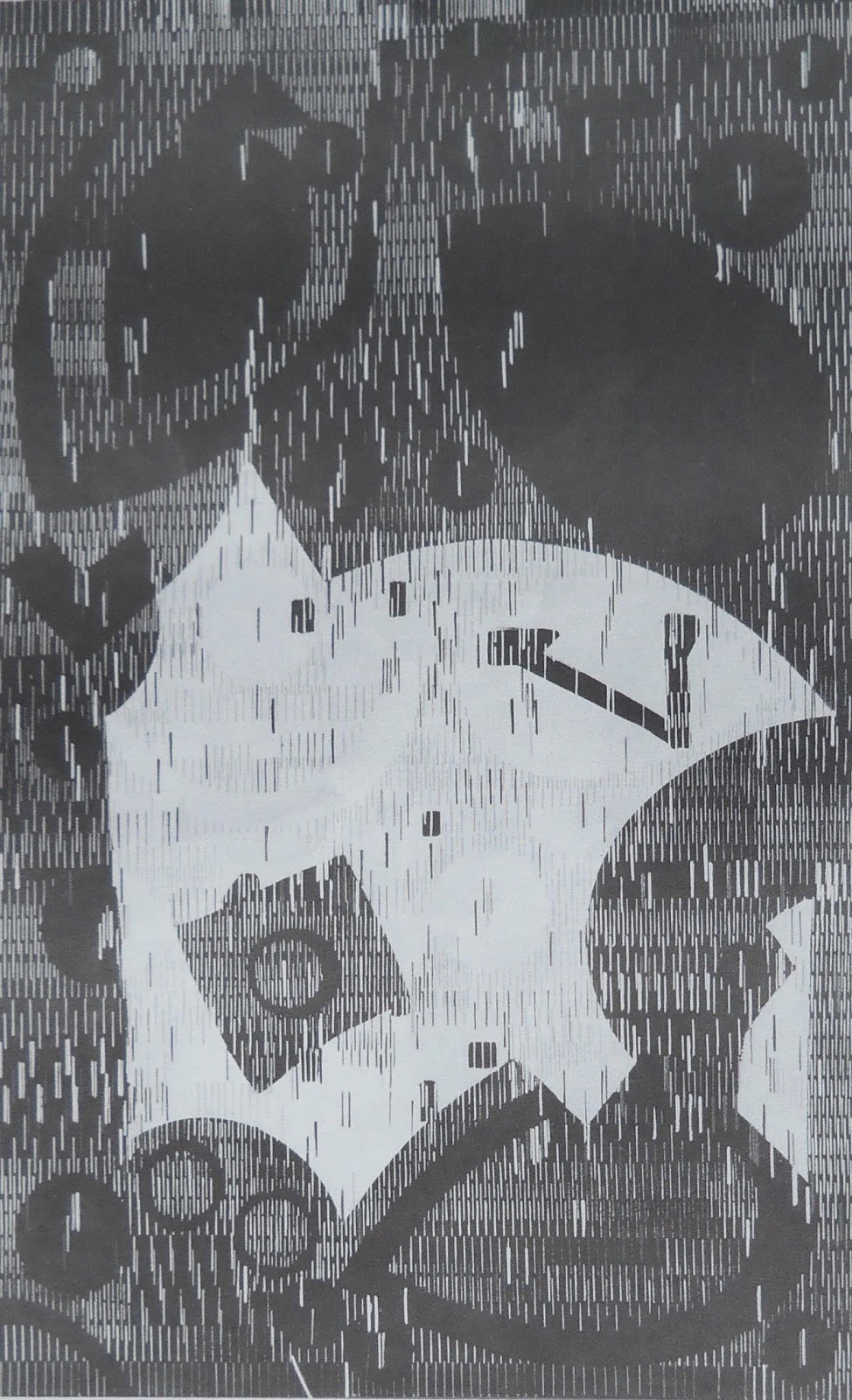
(Poet) Gary Snyder, who’s been important to me.  It’s a line from one of his poems, it fit.  The painting is about rites of passage, time, in the context of where we live.  It’s about a sacred site, a celebrative one, a place where energies converge.  This image wouldn’t have come out of New York City.  You know, as a painter you’re a thief—you have to steal hearts.  It’s strange.  I want to paint for people that have passionate eyes.  Now sometimes you hear people say—especially in academic circles—that abstraction denies information, communication.  But “abstract” means to distill truth, from the Greek.  You’re dealing with the essence rather than the appearance.  Which do you want?  But you always have to be held by the classical rules of composition, our human sense of order on the amorphous swarm of things.
 (Scott’s work is the subject of a one man show at the New Gallery, Taos, through June 16.  His work is also included in New Art New Mexico at the Stables Art Center, Taos, through June 17, and will be shown at the Keats Gallery, Santa Fe, beginning August 15.)
 --Stephen Parks, June, 1984

Tuesday, October 16, 2012

Lee Mullican: An Element of Mystery

L. Mullican, Source Series, alkyd on canvas
Lee Mullican’s technique of painting with the edge of a painting knife is exact, painstaking and original. The measured stripes of paint can fall like rain or swirl like straw in the wind, vibrating softly or intensely. His images, abstracted from natural or ‘guardian’ forms, are concentrated and personal, so much so that they often click into the universal realm of archetype. At 62, Mullican, who has taught painting and drawing UCLA for 20 years, is at the height of his expressive powers. Last year, the Los Angeles Municipal Galleries staged a highly acclaimed 30-year retrospective of his paintings. Opening August 1, the New Gallery, Taos exhibits “The Source,” a new series of paintings. Mullican, who maintains a home in Arroyo Seco, discussed his work last month with ARTlines editor Stephen Parks.
            “’The Source’ was titled by my wife, but that’s what it’s about. It’s very close to nature. The basic shape is one that has always appealed to me. It has many connotations – a head or a tear drop, though in this series I’ve used it as a flower petal. It’s as if I’ve taken a flower apart and reassembled it in a different form . . . it’s a transformation from one context to another. And not only the flower, but also the stem, the leaf. That’s where the painting begins. It’s the creation of a private world that my works have been involved with for 30 years.
            “These paintings are mostly in black and white, with accents of primary colors. They’re different than most of my work, in that they’re built around large shapes. I’m trying to get away from the personages I dealt with the’ Guardian Series,’ though occasionally they still creep in. The flower itself is sort of a personage.
            “Somehow I feel this series was forced on me by the change of decades, the arrival of the
‘80s. I’d been painting for nearly 40 years, and I wanted to break into something new. The ‘Guardian Series’ is built on dark backgrounds, but I felt it would be daring to work in white on black, and bring in color with only accents that work to pervade a whole area.
            “I started painting this way in about 1948, right after moving to San Francisco, though the technique has gone through many transformations. I use a painting knife, and every mark the knife makes is an incident. Four or five marks together make a shape which itself is a new incident. And it builds up that way. There is a rhythm in the process that excites the eye, and promotes, I think, a meditative quality. The paintings create a curious image that’s there and is not there. I create by either the presence or the absence of a stroke. I’ve combined this technique with the brush, too, with layers of transparent imagery that serve as curtains, or veils.
            “In a way, I treat nature in an abstract manner, as any tribal society might. If you’re close to nature, you translate, transcribe it in a personal way. And if you can do that completely, you get to archetype. I try to avoid inserting exact reproductions of Indian shapes or images, though some of them are similar.
            “Another important ingredient of my work, that came out of late surrealism, is working in an automatic way. Other than a few planned things – canvas shape and size, for instance, . . . You think of abstract expressionism, I do the same thing. It seems more rigid in the use of the knife stroke, but each canvas is a surprise to me. Controlled, yes, but unplanned. It’s very exciting to work that way, to see what the result is. It’s comparable to John Cage writing music with the I Ching. The combination of imagination and surprise is very important to me. It yields an element of mystery, which is perhaps the most important ingredient.” 
--Stephen Parks, August, 1981
(Lee Mullican died in July, 1998)

Thursday, May 31, 2012

Eric Orr: Making Art about Light and Death (1982)


We met Eric Orr at the Taylor Gallery in Taos one midmorning following his July 10 opening (the show hangs through August 8).  Looking to be in the latter stages of waking up, he is a shortish, stocky fellow, with closely cropped dark hair flecked with gray, dark eyes, in his forties, and dressed all in white.  We retreated to the kitchen at the rear of the gallery with Eric, accepted a cup of coffee and, while he discussed some details of his impending marriage and wedding with Howard and Mara Taylor, we wandered back into the gallery proper to have a final look before the interview.
Eric Orr has moved, from his first exhibited work at the University of Cincinnati in 1964 (a cocked Colt .45 at eye level  for a seated viewer two  feet away, trigger rigged to a treadle nestled comfortably under one’s right foot) to membership in a West Coast group called by critics, Light and Space or Phenomenological Artists.  Their focus was (and is) on the perceptual process itself, the way one perceives and the manner in which that process of “seeing” may be manipulated or altered.  He has explored techniques and possibilities that are suggested to him by both scientific and ceremonial / ritualistic traditions.
Some of the most arresting works have been his installations.  Sunrise, constructed in the Cirrus Gallery in Los Angeles in 1969, was a room whose outer dimensions measured 9 feet by 9 feet by 18 feet high, its exterior covered by a sheet of lead.  (The dimensions relate to those of the King’s Chamber of the Great Pyramid.)  On the interior wall of the back of the room, the light of the sun was reflected through a channel extending through the roof by a tracking device which followed the course of the sun from dawn to dusk.  Its Egyptian references, the perceptible change in atmosphere created by the lead sheathing outside, which created a “cosmic ray void”, and the room’s eerie silence (the interior walls were heavily insulated) produced a space in which one’s experience of one’s self, of the space, and of the world, was somehow changed, transformed, and altered. 
He has collaborated with Larry Bell on the design of The Solar Fountain, a project begun several years ago and soon to be constructed in Denver.  A bowl of glass some 34 feet in diameter and 10 feet high will sit in a 60 foot reflecting pool.  An agricultural spray system, situated in the middle of the gold coated bowl, produces a fine cloud of water vapor.  The sun reflects gold light onto the cloud and, because of the heat factor which causes a change in the molecular size of the water particles, creates rainbows within the cloud.
At once he rails against “art about art” and the making of art objects, paintings, and sculpture, yet makes them himself.  His efforts are far from ordinary.  The paintings are made from such elements as gold leaf, carbon, human bone, pulverized radio, and human blood, and the sculpture from fire, water, and gold leaf.  As he says, he is interested in “the thing itself.”  He wears his apparent contradictions as an actor wears his roles.  He is engaged and engaging, eager to discuss his work and, it seems, just about anything else.
We talked in the quiet gallery, in the midst of his show,  perched on the bancos around an empty fireplace.
You’re getting married on Sunday.
Getting married on Sunday!

 Why in Taos?
We come out here every New Year’s, pretty much, and we have some friends out here, and I’ve always considered this a kind of special place.  Not necessarily the kind of place I would live, but a place that allows me a certain sense of mind.  I like the environment a whole lot, I like the mountains and the weather.

 I’ve heard that one New Year’s here you did the The Nines . . .
That was the first year we were here, a whole bunch of years ago.  I went around to the trees and took the dead branches that were air-dried, and made a series of nine nines in a pyramid shape in front of Larry Bell’s place.  Then I used old-fashioned gasoline (laughter), poured it over the sticks so there’d be no question of the sticks burning – I always like things to work.

 Like at the Pueblo at Christmas Eve. (More laughter)
You want it to happen, you make it happen.  Then right at New Year’s, I lit ‘em off.  As soon as I lit them, it started to snow.  It was great.  They continued to burn, and there was this white, and The Nines came through.  That was an extra.  I didn’t know that would happen, but it looked great.  It was kind of a ceremony or whatever. 

Why nines?
I’ve always liked nine because it has that additive function.  Four times nine is . . . ?

 36.
Three and six are . . .?

 Nine.
Two times nine is eighteen, eight and one are nine. Nine is the only number that if you multiply it by itself, it will end up as nine.  It’s the only number that will do that, and it gives it an extra little edge, in my book.  I discovered that phenomenon myself (laughter), and of course everybody else in the world . . . you come across something in life and think, “Oh, boy, is this hot,” and of course, everybody else knows about it.  Because of that, I’ve always taken to nine.

 What does that signify to you?
Aamm, I like coincidences of any kind.  A coincidence in a number system is even better, even though I look askance at numbers to begin with.

 You’re not a numbers freak?
 I’m not, but when something really surprises me like nine does, I’ll go for it.

 When you light off nines on New Year’s Eve and it starts to snow, the coincidence and mystery of that . . .
Ya, and nines still appear, like on the Crazy Wisdom piece . . .

 They are nines and not sixes.
Ya, though nines and sixes are friends, and that’s another nice thing about them.  Of course, numbers didn’t appear in terms of Western man until about the 12th century with Leonardo of Pisa who introduced zero to ten.  Until then it was Roman numerals.  So the numbers we’re used to come very late if you look at the whole . . .

 They’re from Arabic?
Originally from the Hindu, and then they get to the Arabic, and finally (laughter) they get across the Mediterranean to Europe by the 12th century.  “You’re a little late guys.”

 That’s kind of like your own travels through art.
My experience with art is one – let’s stop for a moment.  (Orr leaves and returns  a moment later with copies of a statement he prepared for the Documenta exhibit last month in Kassel, West Germany.) . . . What I did was sort of one line statements.  If you read through it, maybe you get one line and it sticks and that’s about all you get from most statements anyway.

 Back to the Nines for a minute.
I’m trying to not be overly archetypal, but having a certain awareness that we’re all superstitious, in spite of knowledge, and information, and logic.  I prefer illogic to logic, for instance, just as a natural tendency, but not to ignore options.  I know that there are certain things that clue me in (he clicks his fingers)  and change my mind, irrespective of over-education, tremendous cynicism, tremendous whatever I have about life and a whole bunch of other things.  I know there are certain things that do make me register, and make me respond.  I try to signature those responses in myself, and then see if those responses are verifiable in other people. 

 What do you mean by “signature?“  Identity?
Identity.  That’s my modern use of the word, like a signature in computers.  And I like the indefiniteness, so these things (indicating the painting on the gallery wall) really relate a whole lot to indefinite space.

 Indefinite and definite at the same time.  Before we started I was looking at these things (the Mu Series) and I felt very much as if I were looking at a real religious painting.  Not an icon, but almost from a blessed place, looking through to an even more blessed place.  The gold frame has a very religious connotation, and then looking through that into something heavenly.
Ya.  My point of view, in terms of religiosity, is, one, I don’t believe in the soul, or the afterlife, or all those nice little things . . . it’s like not believing in Santa Claus when you say that.  And that’s because my tendency is close to the early Buddhist position – that’s Buddhism before you have the icon of Buddha appear – that period lasted for about 300 yearsin which there was no soul, none of the things that the Hindus had, and that’s why Buddha was such a reformer and such a relief from the bureaucracy of Hinduism.  He was addressing that bureaucracy and how rigid it had become and how rigid its ideas were.

 So it was a code of conduct rather than a religious dogma.
When the spiritual nature of man is taken hold of by a priesthood, most of the time it just becomes another bureaucracy.  They set up rules and regulations . . .

 And you’ve searched this out?
I’ve traveled a little bit in my life.  My major hobby is to travel the world.  I was not educated in art.  The way I educated myself was by apprenticing myself to some important artists.  That was after university education, and in terms of art history, I decided to see everything that I thought was interesting on the site.  So I’ve been to most of the major sites of artifacts in the world, and most of the museums.  So, I’ve seen  the real stuff (laughter) rather than the slides of it.  I thought that would be a better way to handle it – just hanging around it.

Who did you apprentice yourself to?
Mark di Suvero was one.  I was very idealistic at a certain point in my life, and he was working on the Peace Tower, and in my last year of university life I decided I better learn a skill (laughter).l  So I learned welding, right, and I started making sculpture, and I thought, “Man, this is it!  I can be paid to do something I like.”  So when I got to California and saw this Peace Tower being built, I went up to di Suvero and said, “I’m a welder, can you use me?”  Gradually we got to know each other pretty well and other stuff came out.

 Let’s go back to your mention of liking the indefinite.  I equated that with infinite and you didn’t object and yet, in reference to these paintings, you said you didn’t believe in the soul or the possibility of that indefinite state afterwards . . .
It’s not indefinite, it’s definite.

 And we ourselves are definitely finite.
(Pause)  Our . . . Ya, absolutely.

 And the idea of the soul is unhelpful, in terms of a person’s . . .
Reconciling death.  And life, which is a mirror of death.

"Crazy Wisdom, lead with human skull fragments, radio,
 blood, and gold,. 14 x 11 inches.
 I read a quote of yours that said death is your best friend.  Do you still believe that?
Oh, absolutely.  In my point of view, art really generated out of views of death.  All Egyptian art was made for the dead.  I was lucky enough, or foolish enough, to run down some shamans in Zaire.  I found myself using some curious materials, and I thought maybe I ought to check out the guys on the job right now.  And what they would do is make a little fetish object, not necessarily figurative, but having the essential ingredients to make the interlock to the afterlife.  They go into a trance and they talk to someone who’s recently dead, usually, and after the conference with the dead person, using the fetish as a guide they come back to straighten out the living.  There might have been a bad bride price, which there usually always is . . .

 A bride price?
You marry one of the family’s clan system to another, all these gifts are exchanged, and no one is ever altogether happy about what happened, and that continues throughout the rest of the person’s life.  So this guy will go into a trance and come back and say, “Well, this person ought to give that person such and such a gift,” and the thing will be settled and the dead guy will be comfortably dead in the afterlife.  I just find that the fact that art’s genesis comes out of the shamanic and then is taken over by religious organizations like the priesthood . . . To ignore the fact that art in the beginning dealt with death, I think it’s a big mistake.  Somehow I think we leech the system or soften its essential nature by doing this.

 What is the statement about death in these paintings?
The only statement about death is that that’s a dead person there (indicating the pieces of a human skull on Crazy Wisdom), and that’s a part of a dead person there (indicating his Mu Series of paintings).  In fact, all of these works have part of a dead person in them.  The color is just ordinary pigment, but here in the cracks (between the canvas and the gold frame) there’s human carbon from human bones.  So they all kind of ride on the surface of someone who is dead.  Someone, not an abstraction of someone.

 Using the object itself . . .
The objects themselves have a dead person in them.

 Whose blood is it?  I just noticed the band-aid on the inside of your elbow . . .
That was for the marriage license!  (Laughter)

 But do you go to the doctor occasionally and have a pint of blood drawn?
Not a pint.  I get these little vials that have anticoagulant in them, which is the saving thing for me in terms of application, and just lay on thin coats of lacquer, blood, lacquer, blood, and the use of those materials, like the stuff that backgrounds this, is only to appeal to the organ of the mind.  Not the eye, or the taste, or the feel organ, but the mental  organ. So it looks like red and it’s fine to me.  And if you find out it’s my blood, then that information has a certain appeal to the brain.

 The brain and then the gut.  When you look at a painting and then realize there’s blood in it, you go, “Where, why, how?”  It’s unsettling in the stomach, to me . . . emotionally. 
But it’s not to me.

 Do you have some shamanistic intent with these?  Are you trying to affect people in that same . . .
I’m trying to make a connection that is in an ancient tradition in art.  I’m going very light right now.  That’s a little heavier over there (Crazy Wisdom), but that’s got radio around it and that lightens it.

 What’s radio?
That’s where you take an AM/FM radio, and take a sander and turn it into dust, and then you put it in a bottle with a screen and shake it on the surface.  So that’s radio and human skull.

 You’re not calling yourself a shaman.
No, I just relate that to the group.  Their support base is so much wider than mine.  Mine is a very limited job description, enough to make you cry.  The job description of the shaman . . . he’s the guy who does rituals, he’s the doctor, he’s the psychiatrist, diplomat, lawyer, tons of things.  He’s the guy that engenders most of the things we think of in terms of professions.

 But is there the intent that these are, in some way, going to affect the viewer on an unconscious or…
Conscious level, in the sense that once you’re given the information, however you get it, that that in a way changes your way of perceiving the object.  Even though it’s not a retinal perceptual change, it’s a mental perceptual change.  I’m using that consciously as part of my art making.  And that in a way is what a shaman does when he puts in the different elements in his work.

 Are they recognizable by the tribe?
Boy, they know what’s in there.

 And your radio can be a very personal object, to me, even though it’s not my radio.  (Laughter)  It’s a common, communal object with an intellectual or conscious reference.
I made spaces (for museum installations) for a long time, and some of them would do what these objects do.  One of these, when you’re living around it, is a very peaceful kind of thing.  In spite of the fact that it’s got all of this other stuff, when you gaze upon it, it relaxes and calms you.  And a lot of the rooms I made did just that.  So, in a way, making these is being more succinct than making a whole room.  These have a longer time base, living around something like this in your home, and that’s something I totally ignored for years.  I thought all this painting and sculpture stuff was just totally quaint, a hangover from another period that didn’t seem to make much sense in this part of the century.  You would have expected art to have gone on, which it has in many areas, and which I attempted to take on myself in other works like room installations.  But then I started realizing that it’s all right here in the mind anyway.  The space you go into for a special kind of situation that you never had before, or something on the wall that has a long time base – if you look at both of them they might have the same effect.  So I started making objects.  Some higher options are set when you start making objects, in the sense that you can do a lot of different things.

 So you’ve come around in your thinking about what’s relevant?
I’ve come around in believing that both the object and the space exist in the memory, ultimately.   I come from a group of people, the Light and Space group in California (an informal group including Larry Bell, Ron Cooper, Laddie John Dill, Robert Irwin, James Turrell, and others), and some of them are just totally against making objects.  I’m a renegade in that system, because some of them think the way I thought.

 There was a comment in the Artforum article (Summer, 1982), in which you said it’s time to stop making art about art.
There’s a lot of art that just refers to art, like the new movement in Expressionism.  This show I was in in Europe (Documenta) had 125 yards of that stuff, and that’s a lot (laughter).  I thought we’d already gone through that period.  I hold a conceit, and it’s not more than that, that by using the real element and not using the metaphor elements, not using symbols, but using it that I’m closer to what I’m up to than imitating or suggesting with a symbol.  If I want elements that key into death, I use things that are one-to-one related to death.

 It’s like the Indians in their ceremonies using eagle feathers rather than  a pictures of eagles.
You bet.

 To change the subject for a second, I want to pose a question to you that you posed to yourself in your statement.
Oh, no!  (Laughter)

 “Does transient afternoon light look better than art?”
(Quickly) Yes!  You’re damned right it does.  That’s why many times I’ve made rooms in which you sit in silence.  At the end of this silent space there’s a bar of light that takes direct sunlight using a machine called a heliostat, that tracks the sun, focuses light down through the lenses, and at the end of that room you see natural light.  You view that transient light that I just hold in one place.

 It is futile, then, for a painter to try and paint a landscape, make it better than it is?  Is that possible?
Oh, that’s the Plato stuff.  He didn’t like the artists because  they were imitating life!  And he thought that was an imitation to begin with.  Forget it.  I’ve never understood that, when you know the landscape’s better than the painting any time.  It’s like dementia.

 Even more abstract than what you’re doing?
I’m trying to deal with mental sets, places that just relax your mind, so that if I’m able to come up with a thought and translate that thought into an object and it does what I want to do, I feel better about it.  Really, all my pieces are pictorial organization things to me.  It’s a matter of learning how to integrate these curious materials so that they do key in responses to me and others, that I know when I go at it.  And that takes time.  I don’t say, “This is it.”  This is beginning stuff.

 What was your major in college?
I majored in philosophy, economics, and ended up in history.  I didn’t get my graduate degree – I walked because I realized I was being groomed to stay on in the camp.  I started making artifacts and stuff, and I thought, now this is a crucial decision.  Where are you going to go?  I liked both a whole lot, but I thought making art I’d have more options in my life.  Alternately, I didn’t know if I wanted to hang around universities.  I loved universities, meeting people who knew a lot about their subjects.  I was really a sucker for the whole information system.  But I realized I liked art better, and decided to do that. 

 You grew up in Kentucky?
Lived there the first 18 years.  The only art around was horses and statues.  I guess my first exposure to art was hitchhiking to New York when I was about 17.  One of my rides dropped me off near the Philadelphia Museum.  I went in and I saw the Arensberg Collection, that was my opening to modern art.  Later on when I was in the university and I thought that maybe I should go to art school and get training and so on . . .

 Did you see the things in Philadelphia by Duchamp?
Yes, I did, and they certainly influenced a lot of my thinking in terms of what was allowed.

 Where do you think you got your capacity for breaking traditional mind sets?
I always thought I just didn’t know any better.

 And nobody ever drummed it into you that you had to know better?
No, it was just a natural inclination.  In reading about art, the first thing that appealed to me were the revolutionaries in art at the turn of the century, the Dada people.  They pretty much broke all the ground for 20th century art, except for conceptual art that occurs later on.  It was so close to my nature anyway, that breaking codes was as easy as not.  The whole thing in art is so chancy anyway, that to be conservative in art just doesn’t make any sense to me anyway.    Now that I’ve grown up a little more (laughter), I’ve found out that most of my colleagues are tremendously conservative, even though this is a group of people who are supposed to be the most creative and adventuresome – they hardly take any friggin’ chances at all.

 Early on you mentioned you were cynical.  What are you cynical about?
I’m cynical about the originality of the artists, about a group who supposedly are the most imaginative, speculative artists who actually are not that.  So they’re really just a part of another code system and are really manipulated tremendously by these fad things that just sweep through art.  Or out here the tendency of the region that just permeates the artifacts being made.  I mean we do write the book, we do have the license, and once you discover that you do have a license, you’re all right.

 You’re free.
That’s right, and then you find out that even though you think you’re free you’re really confined by your own thoughts and all that stuff that makes you not free.  So in terms of the system that I’m in, it’s very corny.  And I don’t know why, because artists most of the time don’t make any money anyway.  So for them to be conservative when they’re not making any money . . . I mean, come on, guys!  Certain European collectors actually purchase spaces, but there was no thought of that when I started making these things.  That, in a way, is why these people in California who started the Light and Space routine, got so far into it, because we weren’t making any money anyway, so you might as well go all the way.  There was no mercantile audience, there were other artists interested in that kind of stuff, but . . .

 Does your work surprise you much?
Not as much as it does when you write a great line.  You know how when you’re writing, “Jeez, I wrote that?” But there’s so much work, just labor, that has nothing to do with so-called art, so many hours of manual labor just to get the whole thing done, that the spark . . . is small.  The great thing about it is when it’s done, you can live around it.

 I guess that spark comes from somebody else’s response to it, and that’s another process in itself. 
Yeah, I get very interested in that in terms of trying to see what I actually do and then how it’s received.  I’m not ashamed of asking someone, pretending to be a neutral observer, “Is this shit art?”  I used to do that with the spaces because they were really going out on an edge.  But being antagonistic like that, I got some interesting responses . . .

 You’re very interested in that . . . That first piece you did of the gun in Cincinnati (Colt 45, see intro.), the use of blood and bones in these pieces elicit a very guilty response.  There seems to be in how one idea terrorizes another, an intent, almost aggressive position.
Well, the aggression of the gun was associated with youth, and like that first Dada work . . . This was more than 20 years ago, and the death and suicide issues, the Vietnam War, they all related in a curious way. And in that period, too, I was interested in the fact that death is the ongoing issue in life. To try and bury or ignore that kind of thinking is denying a very vital part of our existence. If an art object’s sole intention is to question your decisions on life and death,  that was the kind . . . that kind of work comes out.  But what happens many times is another option comes up and you think, well that might be better,  so I try to keep myself open to the other options because I’m always impressed by how you can give up your will to how you fix on an idea. Is that clear?

 Yes. I was just wondering how that objectifies itself in your work.
The blood and the human carbon and all that  are background information, and are not necessary to the viewing of the object. Once you know about it, it’s there, even though your retina doesn’t give you the information. And I like the mind giving you the information rather than the retina. It gives me another edge. I think to deny the senses is silly.

 Rather than just having eye baths, or extraordinary visual  experiences. You ‘ve got a good question in your written statement, referring again to Buddhism, having no soul, no after life, no transmigration. You end up by saying, “Who makes art for the soulless?” That’s a good question.
I know. Actually, I nominated myself. (Laughter) I don’t know how well I’ll do, but I’ll nominate myself. Let me give you one great example of art done by that group, and that is in Anuradhapura, in Ceylon, now called Sri Lanka. There’s a huge domed area right in the middle of this jungle--esque setting, made in that early Buddhist period, and it has nothing inside it. You cannot get to it, inside it. It’s just to hold the nothingness of the space of the interior. That is an example of art made for the soulless, to contemplate the nothingness. You can’t get to it, it’s only done through here (tapping his head).

 Are you political at all?
I was when I was young and idealistic. And now, upon more distant reasoning and reflection . . . No one’s going to stop war. I’m sorry. We haven’t really evolved as a species very much [somewhat nervous laughter], in ideation or action. We’re not that far along the evolutionary scale yet, and to take stands viewing man’s ignorance as a basic dumb activity is really kind of stupid. So when you find out there aren’t any good guys in politics, it really takes the edge off of it. So I’m avid in the reading of it and the knowledge of it because it’s like a book . . .

 Are you pessimistic about the future of mankind?
You mean are we going to get rid of the energy crisis by getting rid of most of the people on the planet? War is inevitable, it always has been. In respect to man’s activities, it’s like the rain.

 What would make that not inevitable?
Evolution of the species.

 When will that happen?
Maybe in 5,000. At our rate.

 And you don’t put much hope in science, either.
[More nervous laughter, sounding agitated]  I love science. I’m a quark fan, a black hole fan, a naked singularity fan, an event horizon fan, I’m a fan of the mythos, and the fact that science engages in more speculative thinking than in my own field, but the warrior still has the checkbook. The scientist works for the warrior in our society, so the best speculative thinking is going to the warrior class.

Opinions like that, which I think I share, can make you cynical and make you fatalistic. . .
Not necessarily, because I’m sorry, we are fatal anyway. In the next 80 years or so, 4 billion people will die of natural causes – that’s a lot of people right there. I just want to get to the birthday. I’d like to see the turn of the century, just because I think it would be a great birthday.

 So it’s like Walter Cronkite, “That’s the way it is”?
No, it’s with humor. It’s the humor of the tragic comedy. If you took the humor out of it, it would be just awful. It’s entertainment and humor, and I am being affected by it, and the conditions are like conditions that build up weather fronts. I’m not going to be able to change that high pressure area over the Pacific, or the one over the Middle East. It’s seeing the situation as I see it, not necessarily as it is. I mean, I’m beclouded by my own prejudices. I don’t feel like I have to demonstrate, or stop the war.

 Or sink into paralytic despair.
No. No despair. It’s no different than my own finite sense of myself. It’s as much a part of things as my own demise. But I have something that I love to do – I love to make the things that I make and I’m passionate about it, and that gives me tremendous amounts of energy and kicks, so I don’t despair about political shenanigans . . .

Or your own personal life?
[Pause] Hmmmm . . . Tragedies whip through your mind. They come and go, and that’s just part of your life. And as you get older, you get more [laughter], which is great. I’ve noticed that tragedies increase as age increases. All your friends around you die, and then you die.


--Stephen Parks, August, 1982